Every founder I talk to has the same problem. Not the idea. The idea is fine. The problem is the feature list.
They show up to the first call with 15-20 features. A dashboard. Notifications. Admin panel. Chat system. Analytics. Integrations. Multi-language support. And they want all of it in the MVP.
That's not an MVP. That's a full product. And it will take 4-6 months and cost $50,000+ to build.
MVP scoping is the most important step in the entire development process. Get it right and you ship in 2-3 weeks for $3,000-$8,000. Get it wrong and you burn months building features nobody uses.
I scope MVPs for founders every week. This article walks you through my actual process. Not a framework from a textbook. The real steps I follow on every project, with a real example from Trackora, the SaaS product I built for my own use.
What does scoping an MVP actually mean?
Product scoping is the process of deciding what goes into your first version and what doesn't. It sounds simple. It's the hardest part of the project.
Good scoping does three things.
Defines the core problem. Not 5 problems. One. The single thing your product does better than anything else on the market.
Draws a line around v1. Everything inside the line gets built. Everything outside waits. No exceptions. No "it's just a small feature." No scope creep.
Creates a buildable plan. A scoped MVP has a clear feature list, a timeline, and a cost. If you can't quote a price for it, it's not scoped.
Most founders skip scoping and jump straight to design or code. That's how you end up 6 weeks into development with a product that's 40% done and 200% over budget.
Why founders scope wrong
I've seen the same mistakes on dozens of projects. Here are the patterns.
Building for every user type at once. Your product might serve freelancers, agencies, and enterprises. But your MVP should serve one of those. Pick the one with the sharpest pain. Build for them. Ignore the rest until v2.
Confusing "nice to have" with "must have." Notifications are nice. A settings page is nice. Dark mode is nice. None of those are MVP features. They don't validate whether anyone wants your core product. Cut them.
Copying competitor feature lists. Your competitor has been building for 3 years with a team of 12. You're starting from zero. Don't try to match their feature list. Beat them on one thing. Do that one thing faster, cheaper, or better.
No clear success metric. If you can't answer "how will I know this MVP worked?" then you haven't scoped it. The MVP needs a measurable goal. 50 signups. 10 paying users. 5 completed transactions. Something concrete.
My scoping process (step by step)
This is the actual process I run on every MVP project. It usually happens during a 45-minute discovery call plus a few days of thinking and writing.
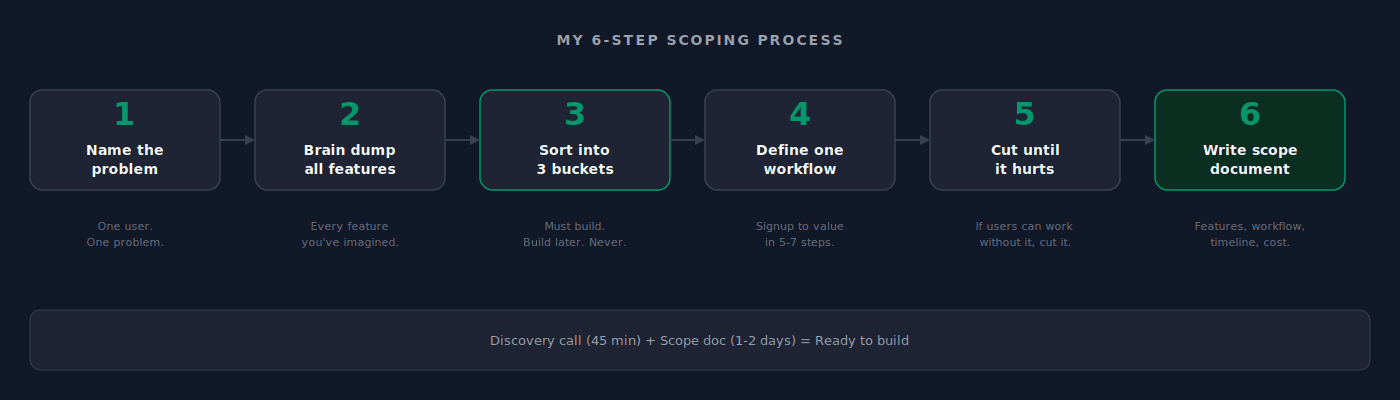
Step 1: Name the problem in one sentence
I ask the founder: "What problem does this solve, and for who?"
If the answer takes more than one sentence, we're not ready to scope. We need to narrow down.
Good answers look like this: "Freelancers lose money because they can't track how long projects actually take vs how long they quoted."
That's Trackora. One sentence. One user. One problem.
Bad answers sound like: "It's a platform for project management and communication and time tracking and invoicing for freelancers and agencies and teams." That's 6 products pretending to be one.
If you've done a value proposition canvas, you already have the answer. The pains and gains map directly to features. If you haven't, do that first.
Step 2: List every feature you want
I tell founders to brain-dump everything. Every feature they've ever imagined. No filter. Write it all down.
This isn't about building everything. It's about getting the full list out of their head so we can sort it. If the ideas stay in their head, they leak back into the project mid-build. That's scope creep. Getting them on paper is how you prevent it.
Step 3: Sort into three buckets
This is where feature prioritization happens. I use a simplified version of the MoSCoW method. Not the full framework with "Won't Have" and "Should Have." Three buckets. That's it.
Must build. Features the product literally cannot work without. If you remove this feature, the product doesn't solve the core problem. For most MVPs, this is 3-5 features.
Build later. Features that make the product better but aren't required to test the idea. These go into v2. Settings pages, admin dashboards, notification systems, integrations. Almost always "build later."
Never build. Features that sound cool but don't solve the core problem. Kill them. Don't put them on a roadmap. Don't promise them to users. They're distractions.
The rule is simple. If a feature doesn't help a user complete the core workflow in their first session, it's not a "must build."
Step 4: Define one workflow
An MVP is not a collection of features. It's one workflow that a user can complete from start to finish.
I ask: "What does the user do from the moment they land on the app to the moment they get value?"
For Trackora: Sign up. Create a project. Add an estimate. Start a timer. See how actual hours compare to the estimate. That's the workflow. Everything else is extra.
For a marketplace MVP: Sign up. List an item. Another user finds it. They contact the seller. Done. No reviews, no favorites, no advanced search. Those come later.
For a SaaS dashboard: Sign up. Connect data source. See the dashboard. That's it.
If your workflow has more than 5-7 steps, you're building too much.
Step 5: Cut until it hurts
This is where founders push back. Every time. "But we need notifications." "But we need an admin panel." "But what about mobile?"
My test for every feature: "If we launch without this, can a user still complete the core workflow?"
If yes, cut it. Ship without it. Add it in v2 when you have real user feedback telling you it's needed.
I've had founders cut their feature list from 18 items to 6 during a single call. That's normal. That's the point. Fewer features means faster delivery, lower cost, and a product you can actually test.
Step 6: Write the scope document
After sorting, I write a one-page scope doc. It covers the core problem in one sentence, the target user in one sentence, and the must-build feature list (3-6 items). Then the workflow step by step, what's explicitly out of scope, timeline, and cost.
This document becomes the contract. If a feature isn't on this list, it doesn't get built. If the founder wants to add something mid-project, we look at the scope doc together. Something else has to come out to make room.
Real example: how I scoped Trackora
Trackora is a SaaS tool I built for freelancers. It tracks project time and compares actual hours to estimates. Here's how I scoped it.
The problem: Freelancers quote a fixed price for projects but have no idea how long the work actually takes. They either overcharge and lose clients or undercharge and lose money. There was no simple tool that compared estimates to actuals in real time.
The brain dump (everything I wanted):
- User auth (signup, login, password reset)
- Project creation with estimates
- Time tracking with start/stop timer
- Estimate vs actual comparison dashboard
- Team member management
- Client portal
- Invoicing
- Recurring tasks
- Tags and categories
- Reports and exports
- Stripe integration for billing
- Notifications
- Mobile app
- Dark mode
- API for integrations
That's 15 features. Building all of them would take 3-4 months.
The sort:
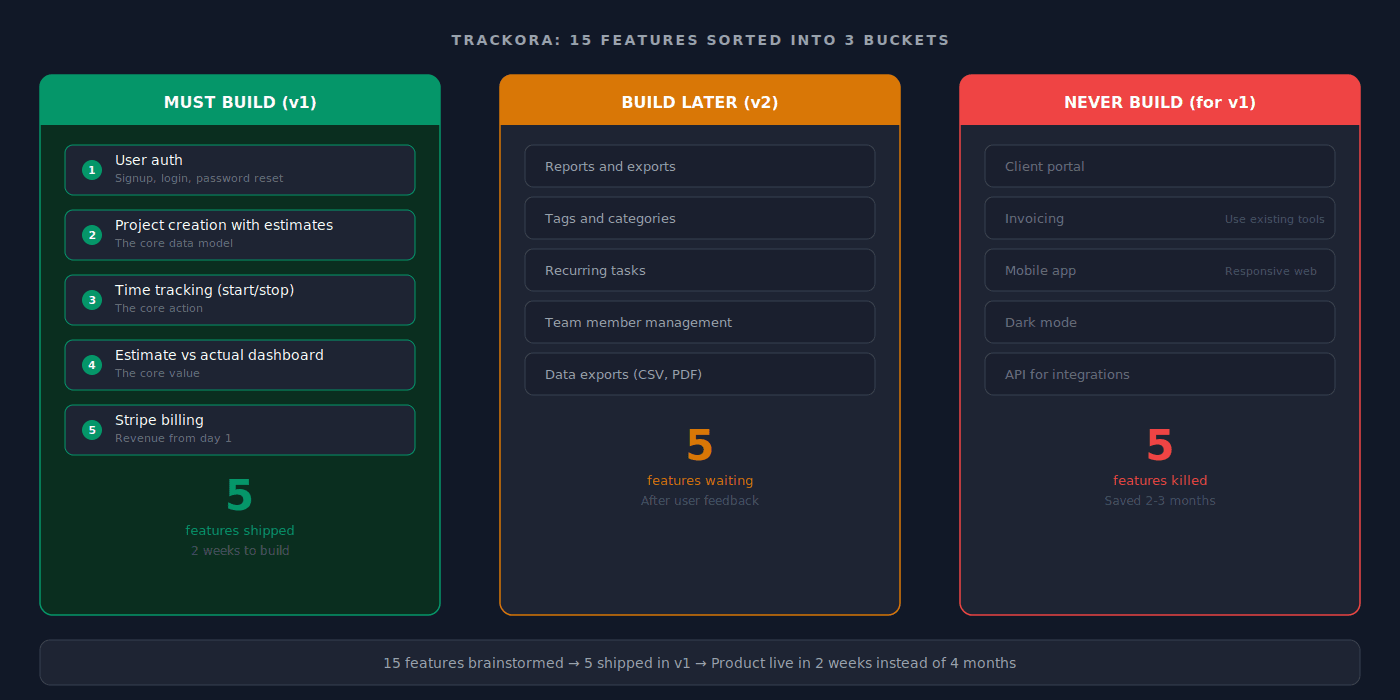
Must build: auth, project creation with estimates, time tracking, estimate vs actual dashboard, Stripe for billing.
Build later: reports, tags, recurring tasks, team management, exports.
Never build (for v1): client portal, invoicing (use existing tools), mobile app (responsive web is enough), dark mode, API, notifications.
The workflow: Sign up. Create a project. Set an estimate. Start a timer. Check the dashboard to see estimated vs actual hours.
What got cut and why:
I wanted team management. Cut it. Trackora is for solo freelancers first. Teams come later if solo users love it.
I wanted invoicing. Cut it. Freelancers already use tools for invoicing. Trackora doesn't need to replace them. It needs to give them data they don't have.
I wanted a mobile app. Cut it. A responsive web app works on phones. Native mobile is a v2 feature once I know people actually use the product.
The result: 5 core features. 2 weeks to build. Total cost would have been about $3,000-$4,000 if I'd hired someone. I built it myself because I'm the target user.
The first version was ugly. Limited. Missing features. But it worked. I could track estimates, run timers, and see the gap. That was enough to validate the idea.
If you want to understand the difference between testing technical feasibility vs testing market demand, my PoC guide covers when to use each approach.
The MoSCoW method (practical version)
You'll see MoSCoW prioritization mentioned in every product management article. Here's the version that actually works for MVP scoping.
MoSCoW stands for Must Have, Should Have, Could Have, Won't Have. For MVP scoping, I collapse this into three buckets. The distinction between "Should" and "Could" doesn't matter at this stage.
Must Have = The product breaks without it. Auth is always a must. The core feature is always a must. Payment processing is a must if you're charging. Almost nothing else is.
Should Have = Makes the product better, but users can live without it for now. This is your v2 list. Don't touch it during the MVP build.
Won't Have = Doesn't serve the core user or core problem. Delete it from the backlog entirely.
The mistake people make with MoSCoW prioritization is putting too many things in "Must Have." I've seen founders put 12 features in Must Have. That's not prioritization. That's a wish list with a label.
If your Must Have list has more than 6 items, you haven't prioritized. Go back and cut.
How scoping affects cost and timeline
This is the part founders care about most. Here's the relationship.
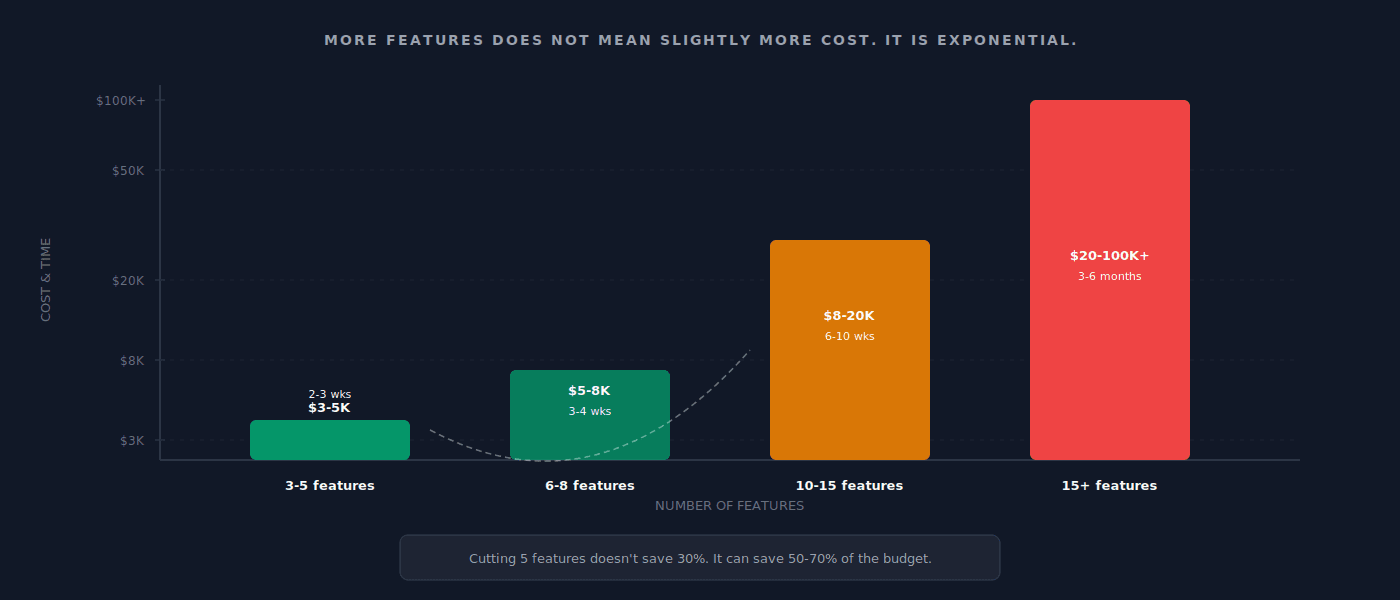
3-5 features: 2-3 weeks. $3,000-$5,000. 6-8 features: 3-4 weeks. $5,000-$8,000. 10-15 features: 6-10 weeks. $8,000-$20,000. 15+ features: 3-6 months. $20,000-$100,000+.
These are real ranges from my work and from agencies I've seen quote similar projects. The jump from 5 features to 15 features isn't 3x the cost. It's 5-10x. Because more features means more interactions between features, more edge cases, more testing, more bugs.
This is why scoping matters. Cutting 5 features doesn't save you 30% on the budget. It can save you 50-70%. And it gets your product in front of users months earlier.
For a deeper look at what goes into an MVP development project from start to finish, my full guide covers pricing, timelines, and the entire process.
5 rules I follow on every scoping session
1. One user type. Pick the most painful problem for one specific person. Build for them. Everyone else can wait.
2. One workflow. The user should be able to go from signup to value in under 5 minutes. If it takes longer, you've built too much.
3. No admin panel in v1. You can manage data directly in the database for the first 50 users. An admin panel is a v2 feature.
4. No notifications in v1. Email notifications, push notifications, in-app notifications. All nice. All unnecessary for validating the idea. Skip them.
5. Responsive web, not native mobile. A responsive web app works on every device. Building a separate iOS and Android app triples your scope and cost. Don't do it for the MVP.
When to revisit scope
Scoping isn't permanent. You revisit it at two points.
After user feedback. Once real people use your MVP, they'll tell you what's missing and what's unnecessary. Their feedback should drive v2 scope, not your assumptions.
After traction. 100 users are actively using the product. 40 of them ask for the same feature. That feature just moved from "build later" to "must build." Let the data decide, not your gut.
The biggest risk in product development isn't building something broken. It's building something nobody asked for. Tight scoping protects you from that risk. You don't need a technical co-founder to get this right. You need a developer who knows how to ask the right questions and cut the right features.
How many features should an MVP have? Most good MVPs have 3-6 core features. That's enough to deliver one complete workflow. If your feature list has more than 8 items in the "must build" category, you haven't scoped tightly enough. Cut until the product does one thing well.
What is MVP feature prioritization? Feature prioritization is the process of deciding what to build first and what to skip. For MVPs, I use a simplified MoSCoW method with three buckets: must build, build later, and never build. The goal is to ship the smallest product that still solves the core problem for your target user.
How long does MVP scoping take? For most projects, 1-3 days. I usually cover 80% of the scoping on a single 45-minute discovery call. The rest is me writing the scope document and thinking through edge cases. Some founders come in with a clear idea and we scope in 30 minutes. Others need a few rounds of back-and-forth.
Should I use MoSCoW prioritization for my MVP? MoSCoW works well for MVP scoping when you keep it simple. I use three buckets instead of four. The distinction between "Should Have" and "Could Have" doesn't matter at the MVP stage. What matters is separating the 3-5 features your product can't work without from everything else.
How do I know if my MVP scope is too big? Three signs. Your feature list has more than 8 items. Your timeline estimate is over 6 weeks. Your cost estimate is over $10,000. If any of these are true, go back and cut features. Ask yourself: "Can a user complete the core workflow without this?" If yes, cut it.
What is the difference between scoping and planning? Scoping defines what you're building. Planning defines how and when you'll build it. Scoping comes first. You can't plan a timeline or budget until you know exactly which features are in and which are out. I scope before quoting a price or timeline for any project.
Start here
If you have an idea and a long feature list, you're in the right place. But you're not ready to build yet. You need to scope first.
Here's what to do right now. Write down every feature you want. Sort them into three buckets: must build, build later, never build. Be brutal. If your "must build" list has more than 6 items, cut until it does.
If you want help with that, I do this on every project. The discovery call is free. I'll ask questions, challenge your feature list, and help you find the smallest version worth building.
Most MVPs start at $3,000. Delivery in 2-3 weeks.
Tell me what you're building. I'll get back to you within 24 hours.