Everyone tells you the same thing. "You need a technical co-founder." Investors say it. Startup advisors say it. Every blog post about starting a tech company says it.
So you spend months looking for one. You go to startup events. You post on CoFoundersLab. You message developers on LinkedIn. And you learn what most non-technical founders learn: good developers don't want to work for equity alone. They have jobs paying $150,000+. Your pre-revenue startup with no users and no funding isn't a compelling offer.
Meanwhile, your idea sits in a Google Doc. Waiting.
Here's what nobody tells you: you might not need a technical co-founder at all. What you need is someone who can think through the product with you and then build it. Fast, for a fixed cost, without giving up a chunk of your company.
That's what I do. I'm a solo developer who works with founders to scope, design, and ship MVPs. Most projects take 2-3 weeks and start at $3,000. No equity. No 6-month search. No co-founder drama.
This article explains when a technical co-founder makes sense, when it doesn't, and what the alternatives actually look like.
What a technical co-founder actually does
Before talking about alternatives, it's worth understanding what a technical co-founder actually brings to the table. It's more than writing code.
A good technical co-founder does three things:
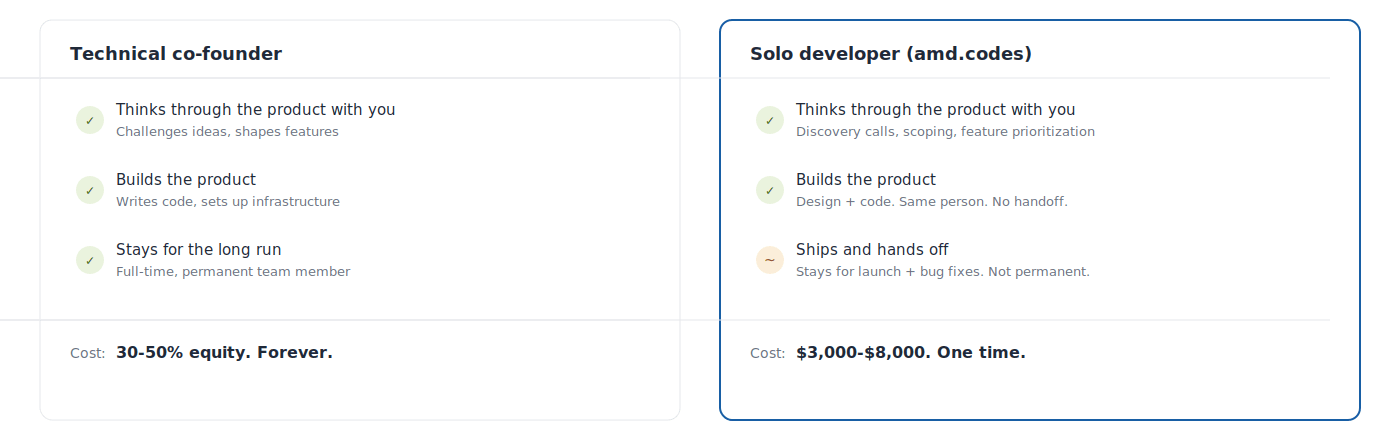
1. Thinks through the product with you. They sit with you on calls, challenge your assumptions, help prioritize features, and figure out what to build first. They're not waiting for a spec. They're helping create it.
2. Builds the product. They write the code, set up the infrastructure, deploy the app. This is the part everyone focuses on, but it's only one-third of the job.
3. Stays for the long run. They're invested in the company. They iterate after launch, fix bugs, add features, scale the product as it grows. They're not walking away after the first version ships.
The question isn't "do I need these things?" You do. The question is "do I need all three from one person who owns 30-50% of my company?"
For most early-stage founders, the answer is no.
Why the co-founder search fails
Finding a technical co-founder is one of the hardest things in the startup world. Here's why.
The talent pool is tiny. Good developers are in high demand. They're earning $120,000-$200,000+ at established companies. Asking them to quit their job and work for equity in an unvalidated idea is a tough sell.
You're competing with every other non-technical founder. There are far more founders looking for technical co-founders than there are developers willing to be one. The ratio is brutal.
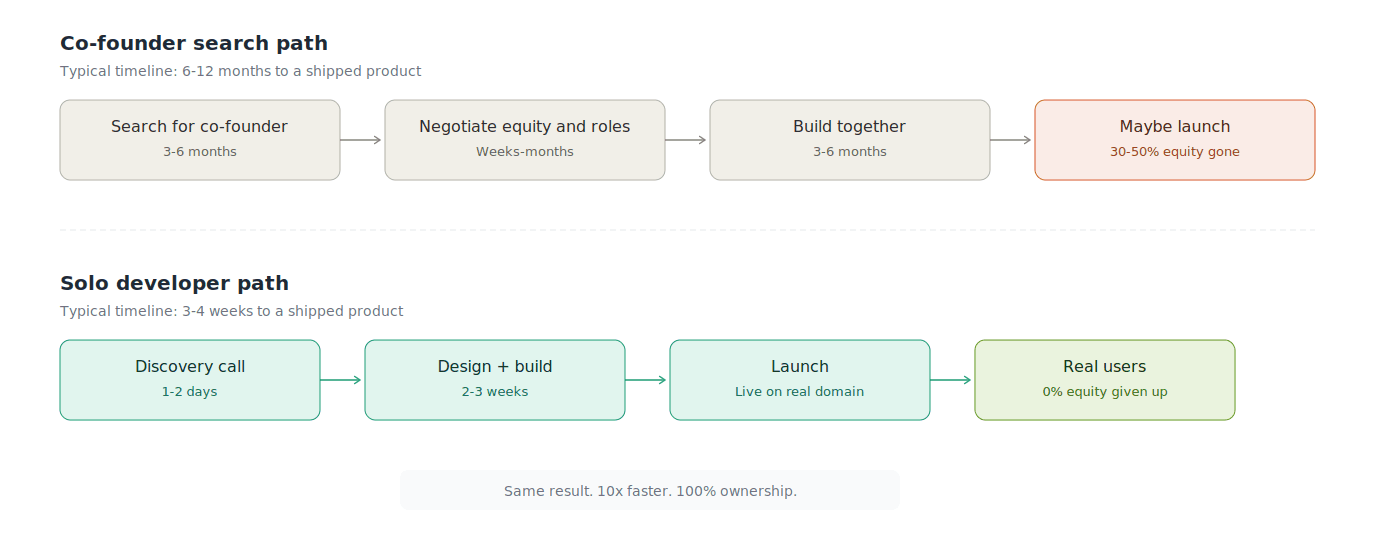
It takes months. The average co-founder search takes 3-6 months. Some founders spend over a year. That's a year of no progress on the product while the market moves.
Equity is expensive and permanent. If you give a co-founder 30-50% equity, that's 30-50% of everything your company ever becomes. And if the co-founder leaves after 6 months (which happens often), you've given away a massive piece of your company for a half-finished product.
Misalignment kills companies. Co-founder conflicts are one of the top reasons startups fail. Different visions, different work speeds, different risk tolerance. You're entering a business marriage with someone you barely know.
None of this means co-founders are bad. Some of the best companies in the world were built by co-founding teams. But for a founder who needs to test an idea and get it in front of users, the co-founder search is often a trap. It delays everything.
The 4 alternatives (and when each makes sense)
There's no single replacement for a co-founder. Different options fit different stages. Here's an honest breakdown.
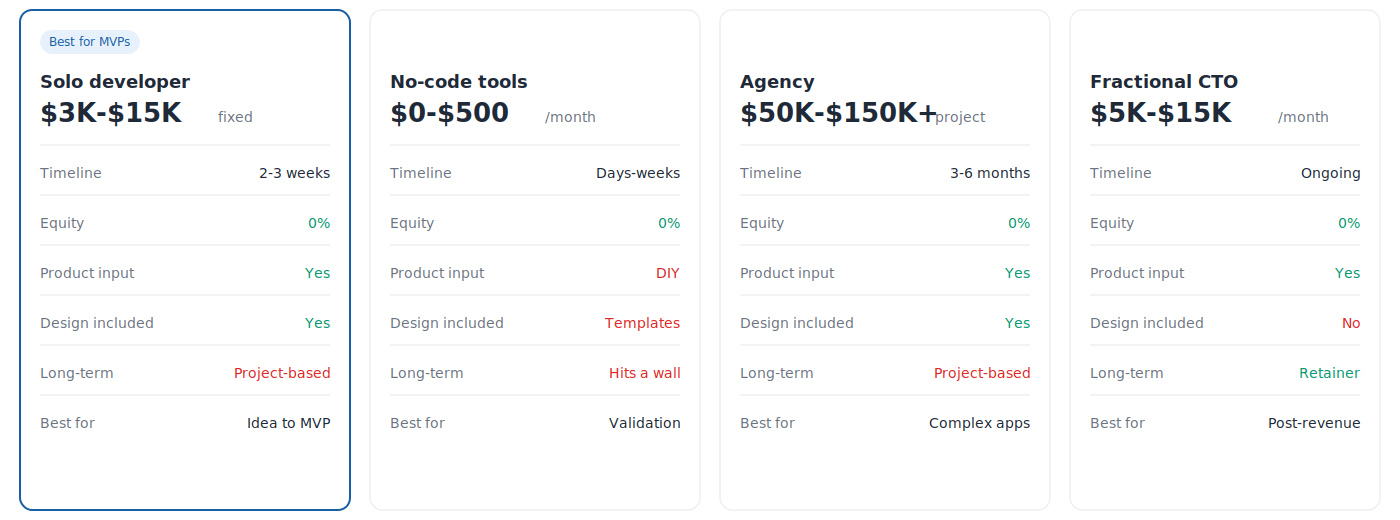
1. Solo full-stack developer (what I do)
One person who handles discovery, design, and development. You describe the product. They help shape it, then build it.
Best for: Pre-revenue founders who need to go from idea to working product in weeks, not months. Budget: $3,000-$15,000.
What you get: A shipped product. Live on a real URL. With auth, core features, responsive design, and deployment. You own 100% of the code and the company.
What you don't get: Someone who stays full-time after launch. A solo developer builds, ships, and hands off. Some (including me) stick around for bug fixes and iterations. But it's not the same as having a full-time technical person on your team forever.
When this works: You have an idea (clear or rough) and need to validate it fast. You don't want to spend 6 months searching for a co-founder before writing a single line of code.
2. No-code tools (Bubble, Webflow, Glide)
Build a basic version of your product yourself using drag-and-drop platforms. No code, no developer.
Best for: Extremely early-stage validation. Landing pages, waitlists, simple CRUD apps. Budget: $0-$500/month in tool subscriptions.
What you get: Something functional, fast. Good for testing whether anyone cares about your idea before investing real money.
What you don't get: A product you can scale. No-code tools hit a wall when you need custom business logic, real-time features, complex integrations, or performance at scale. Most founders who start with no-code end up rebuilding in custom code within 6-12 months.
When this works: You haven't validated demand yet and you want to test the idea for near-zero cost. Use no-code to prove people want it, then hire a developer to build the real version.
3. Development agency
A team of designers, developers, project managers, and QA engineers who build your product as a client project.
Best for: Funded startups with $50,000+ budgets who need complex, multi-platform products. Enterprise features, compliance requirements, large-scale apps.
What you get: A professional team with structured processes, documentation, and project management. Multiple people working in parallel.
What you don't get: Speed. Agencies typically quote 3-6 months. They also have overhead. Project managers, account managers, QA leads. You're paying for the team structure, not just the code. And you rarely talk directly to the person writing the code.
When this works: You have funding, a complex product that genuinely needs a team, and the budget to afford $50,000-$150,000+ for the build.
4. Fractional CTO / CTO as a service
A senior technical leader who works part-time for your company. They advise on architecture, help hire developers, and oversee the technical direction.
Best for: Startups with $10,000+ MRR that already have a product and need ongoing technical leadership without hiring a full-time CTO at $200,000+/year.
What you get: Strategic guidance, architecture decisions, help hiring and managing developers. Someone who thinks like a co-founder without the equity commitment.
What you don't get: A builder. Most fractional CTOs advise and manage. They don't write code. You still need developers to do the actual building.
When this works: You're past the MVP stage. You have revenue. You need someone to guide technical decisions as you scale. This is not an MVP-stage solution.
Why I'm the co-founder alternative for MVP-stage founders
I'll be direct about what I offer and what I don't.
What I do that a co-founder does:
- I think through the product with you. On the discovery call, I ask questions, challenge assumptions, and help figure out what to build first. Half the founders I work with come in with a rough idea, not a finished spec. That's fine. Scoping is part of my process.
- I build the product. Design and code. Same person. No handoff between a designer and a developer. You see working screens by week 1.
- I stick around after launch. I set up monitoring, squash bugs, and stay available for the first few weeks after the product goes live.
What I don't do that a co-founder does:
- I'm not a permanent team member. After the MVP ships and stabilizes, the engagement ends (unless you hire me for v2 or ongoing work).
- I don't manage a team of developers for you. If your product grows to the point where you need 3-5 engineers, you'll need a CTO or technical lead. That's a different role.
- I don't take equity. That's a feature, not a limitation. But it also means I'm not financially tied to the long-term success of the company the way a co-founder would be.
The tradeoff in plain terms: You get speed (2-3 weeks), cost transparency ($3,000-$8,000), and full ownership of the code and the company. You give up long-term technical partnership. For most founders at the idea stage, that's the right tradeoff. Test the idea first. Hire the full-time CTO later, when you have revenue and know what you're building.
Real example: how this works in practice
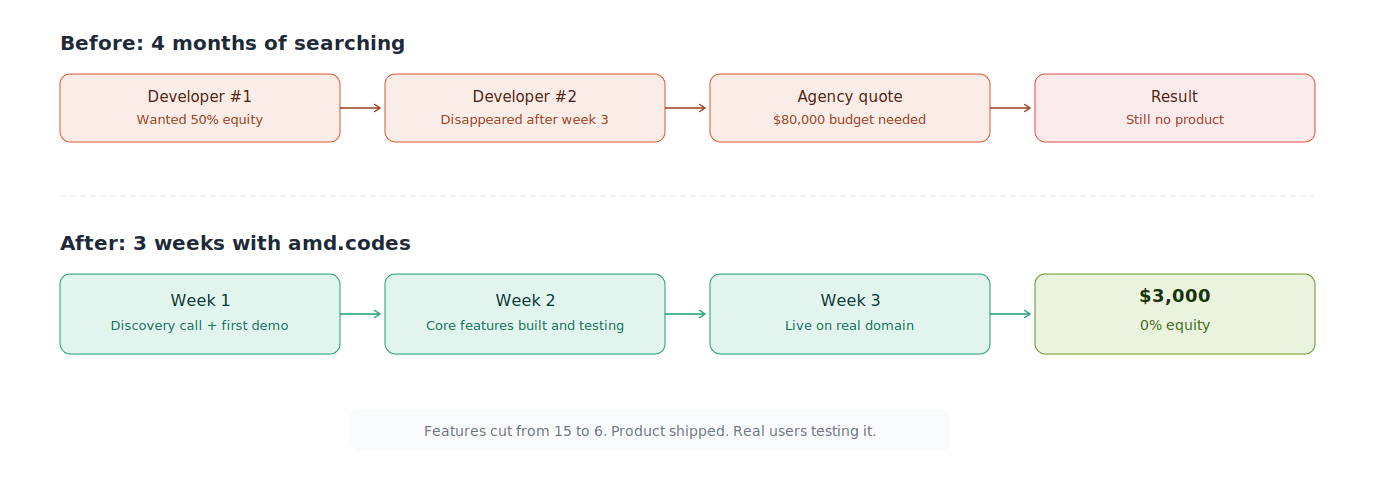
A founder comes to me with an idea for a SaaS tool. They've been looking for a technical co-founder for 4 months. They've had a few conversations but nothing stuck. One developer wanted 50% equity. Another started building but disappeared after 3 weeks. A third wanted $80,000 upfront.
The founder books a call with me. We spend 45 minutes talking through the idea. I ask who the user is, what problem they're solving, and what the smallest version of the product looks like. By the end of the call, we've cut the feature list from 15 items to 6.
I send a proposal: $3,000, 2-3 weeks, Nuxt.js + Supabase + Tailwind CSS. Design included.
Week 1, they have a working demo with auth and the core feature. Week 2, secondary features are built and they're testing the product with real data. Week 3, it's live. Real domain, HTTPS, monitoring set up.
Total time from first call to live product: about 3 weeks. Total cost: $3,000. Equity given up: zero.
Compare that to 4 months of searching, a 50% equity offer, and a developer who disappeared after 3 weeks.
This isn't a hypothetical. It's how most of my projects go. The details change. The pattern doesn't.
How to decide what you need
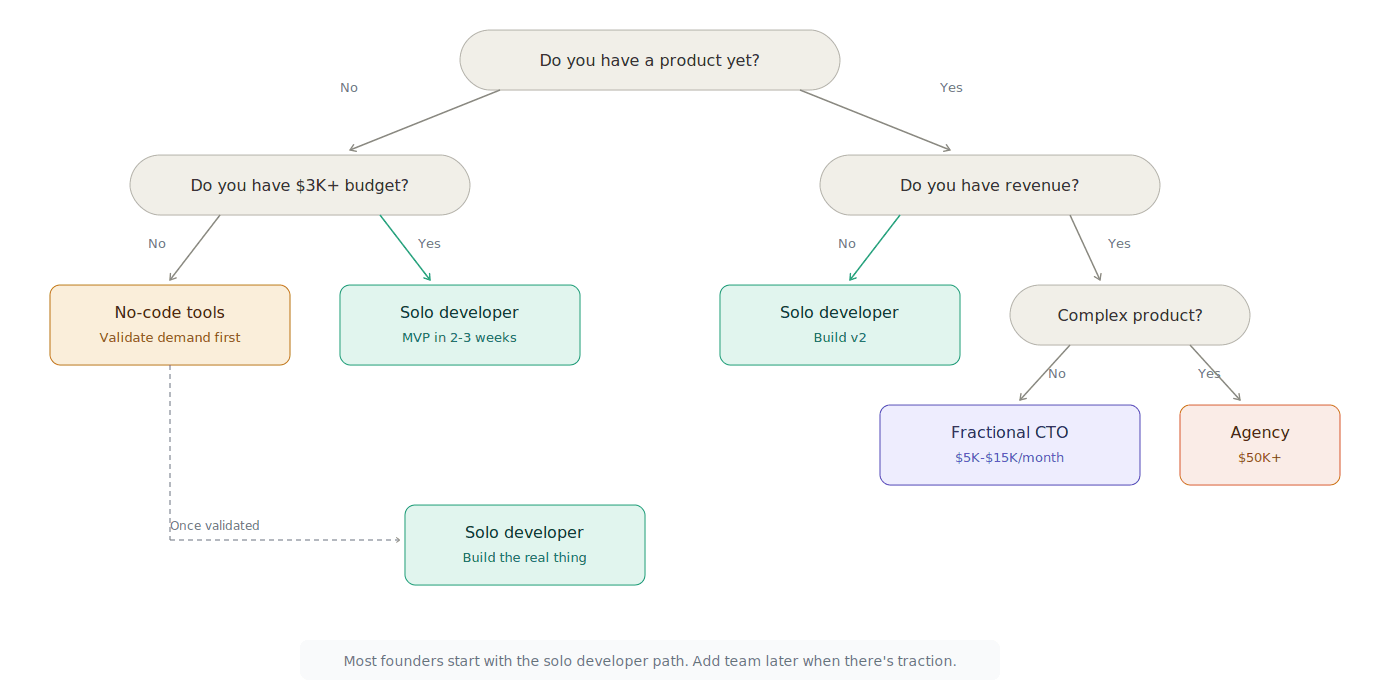
Here's the shortest version.
You have an idea and no product. Hire a solo developer to build the MVP. Test whether people want it. 2-3 weeks, $3,000+.
You have traction and need to iterate. Hire a solo developer or a small team for v2. Or bring on a fractional CTO to guide the technical direction.
You have revenue ($10,000+ MRR) and need to scale. Now consider a technical co-founder, full-time CTO, or fractional CTO. You have traction. Good developers want to join companies with paying users, not just ideas.
You have a complex product that needs a team from day one. Hire an agency. Budget $50,000+. Accept the 3-6 month timeline.
You want to test demand before spending anything. Use no-code tools. Build a landing page. Collect signups. Validate first, build later.
The mistake most founders make is jumping straight to "I need a co-founder" when what they actually need is "I need my idea built so I can test it." Those are different problems with different price tags.
Do I need a technical co-founder to build an MVP? No. Most early-stage founders don't need a co-founder to build their first product. A solo full-stack developer can scope, design, and ship an MVP in 2-3 weeks for $3,000-$8,000. You keep 100% equity and 100% ownership of the code. A co-founder makes more sense later, when you have traction and need full-time technical leadership.
What are the alternatives to a technical co-founder? Four main options. A solo full-stack developer who handles discovery, design, and code for a fixed price ($3,000-$15,000). No-code tools like Bubble or Webflow for early validation at near-zero cost. A development agency for complex, funded projects at $50,000-$150,000+. A fractional CTO for startups with revenue that need ongoing technical leadership.
How much equity should I give a technical co-founder? Co-founders typically receive 30-50% equity. That's permanent. If the relationship doesn't work out, unwinding equity is painful. An alternative is hiring a developer for a fixed cost, keeping 100% ownership, and bringing on a co-founder later when you have traction and can attract better candidates.
What is the difference between a solo developer and a technical co-founder? A solo developer scopes, designs, and builds your MVP for a fixed cost and timeline. They help shape the product during discovery and stick around after launch for bug fixes. But they're not a permanent team member. A co-founder is a permanent partner who takes equity, makes long-term technical decisions, and stays with the company. For MVP-stage founders, a solo developer is usually the better fit.
When should I hire a fractional CTO instead of finding a co-founder? A fractional CTO makes sense when you have $10,000+ MRR, an existing product, and need ongoing technical leadership without hiring a full-time CTO at $200,000+/year. They advise on architecture, help hire developers, and guide technical direction. They're not an MVP-stage option. Most fractional CTOs advise and manage but don't write code themselves.
Why is it so hard to find a technical co-founder? Good developers earn $120,000-$200,000+ at established companies. Asking them to quit for equity in an unvalidated idea is a tough sell. There are also far more founders searching than developers willing to co-found. The average search takes 3-6 months. Instead of searching, build the MVP first with a solo developer. A working product with real users is the best tool for attracting a co-founder later.
Start here
If you've been searching for a technical co-founder and getting nowhere, stop searching. Build the MVP first. Test the idea. Get users. Get feedback. Get traction.
Then, when you're ready for a technical co-founder or CTO, you'll have something to show them. A working product with real users is the best recruiting tool in the startup world. Nobody wants to co-found a Google Doc. Everyone wants to co-found a product with paying customers.
I take founders from idea to shipped MVP in 2-3 weeks. Design included. Most projects start at $3,000.
Tell me what you're building. I'll get back to you within 24 hours.